







Love having fun in the sun?

Sun damage on your face and scalp may indicate something more serious called actinic keratosis (AK)1

Love having fun in the sun?

Sun damage on your face and scalp may indicate something more serious called actinic keratosis (AK)1

Love having fun in the sun?

Sun damage on your face and scalp may indicate something more serious called actinic keratosis (AK)1

AKs are precancerous spots that can turn into skin cancer1,2

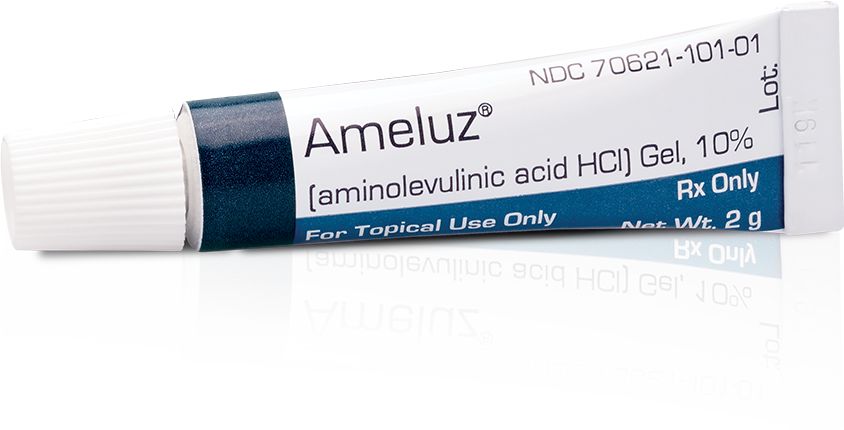
AMELUZ® (aminolevulinic acid HCl) topical gel, 10% with BF-RhodoLED® or RhodoLED® XL treats mild-to-moderate AK lesions on the face and scalp.3

AMELUZ® with BF-RhodoLED® or RhodoLED® XL lamp is the first and only combination product for PDT approved for field-directed treatment of AK of mild-to-moderate severity on the face and scalp.3

Do not use if you have a:

  • Known hypersensitivity to photoactive substances known as porphyrins.
  • Known hypersensitivity to soybeans.
  • Known hypersensitivity to any component of AMELUZ®.

Questions

If you have any questions about AMELUZ®, please contact your health care provider.

Questions

If you have any questions about AMELUZ®, please contact your health care provider.

INDICATION AND IMPORTANT SAFETY INFORMATION

INDICATION

AMELUZ® (aminolevulinic acid hydrochloride) topical gel, 10%, a porphyrin precursor, in combination with photodynamic therapy using BF-RhodoLED® or RhodoLED® XL lamp, is used for lesion-directed and field-directed treatment of actinic keratoses of mild-to-moderate severity on the face and scalp.

IMPORTANT SAFETY INFORMATION

Purpose: Photosensitizing agent

Uses: AMELUZ®, a porphyrin precursor, in combination with photodynamic therapy using BF-RhodoLED® or RhodoLED® XL lamp, is used for lesion-directed and field-directed treatment of actinic keratoses of mild-to-moderate severity on the face and scalp.

Warnings:

Do not use if you have a:

  • Known hypersensitivity to photoactive substances known as porphyrins.
  • Known hypersensitivity to soybeans or to any component of AMELUZ®.

Ask your health care provider before use if you have:

  • Porphyria (hereditary disease that is characterized by abnormal production of a red blood pigment called heme).
  • Photodermatoses (skin conditions caused by or made worse by exposure to light or ultraviolet radiation).

When using this product:

  • Allergic Reactions: AMELUZ® may cause allergic reactions before photodynamic therapy. AMELUZ® should be washed off, and suitable treatment started. The allergic reactions can potentially include severe courses like sudden, severe allergic reaction with breathing difficulty, swelling, lightheadedness, fast heartbeat, sweating, and loss of consciousness.
  • Transient Amnestic Episodes: Photodynamic therapy may cause transient amnestic episodes (temporary loss of memory). If observed, the therapy must be stopped immediately. If observed after treatment, contact your health care provider.
  • Risk of BF-RhodoLED® or RhodoLED® XL Lamp–Induced Eye Injury: Patients and health care providers must wear protective eyewear while operating BF-RhodoLED® or RhodoLED® XL.
  • Ophthalmic Adverse Reactions: Avoid applying AMELUZ® into the eyes. Wash eyes with water in case of accidental contact.
  • Increased Photosensitivity: Avoid sun exposure on the treated lesion sites and surrounding skin for approximately 48 hours following treatment.
  • Risk of Bleeding in Patients With Coagulation Disorders: Special care should be taken to avoid bleeding during lesion preparation in these patients. Bleeding must be stopped before application of the gel.
  • Mucous Membrane Irritation: Avoid direct contact of AMELUZ® with the mucous membranes. Wash with water in case of accidental contact.
  • Concomitant Use of the Following Medications: May increase the intensity of adverse reactions after light exposure related to photodynamic therapy: St. John’s wort, griseofulvin, thiazide diuretics, sulfonylureas, phenothiazines, sulphonamides, quinolones, and tetracyclines.

Most common side effects at the application site are:

  • skin reddening
  • pain/burning
  • irritation
  • swelling
  • itching
  • scaling of the skin
  • scabbing
  • hardening
  • blistering

Most side effects occurred during illumination or shortly afterwards, were generally of mild or moderate intensity, and lasted for 1 to 4 days in most cases; in some cases they persisted for 1 to 2 weeks or even longer.

Pregnancy Warning: There is no available data on AMELUZ® use in pregnant women to inform a drug associated risk.

Lactation Warning: There is no available data regarding the presence of the active ingredient (aminolevulinic acid hydrochloride) in human milk, or the effects of aminolevulinic acid hydrochloride on the breastfed infant or on milk production.

Pediatric Warning: Safety and effectiveness in patients below the age of 18 has not been established.

Geriatric Warning: No overall differences in safety or effectiveness were observed between older (65 years and older) and younger patients, but greater sensitivity of some older individuals cannot be ruled out.

Directions:

  • AMELUZ® is administered only by a health care provider.
  • AMELUZ® is for topical use only.
  • Photodynamic therapy with AMELUZ® involves preparation of lesions, application of the product, occlusion and red light illumination with BF-RhodoLED® or RhodoLED® XL. No more than 6 grams of AMELUZ® should be used at one time.
  • Retreat lesions that have not completely resolved 3 months after the initial treatment.

Inactive ingredients: xanthan gum, soybean phosphatidylcholine, polysorbate 80, medium-chain triglycerides, isopropyl alcohol, dibasic sodium phosphate, monobasic sodium phosphate, sodium benzoate, and purified water.

  • Store in a refrigerator, 2°C – 8°C (36°F – 46°F). Excursions permitted to 15°C – 30°C (59°F – 86°F).
  • The risk information provided here is not comprehensive. To learn more, talk about AMELUZ® with your health care provider. The FDA-approved product labeling can be found at https://us.ameluz.com/pi.
  • You are encouraged to report side effects of AMELUZ®. Please contact Biofrontera Inc. at 1-844-829-7434 or FDA at 1-800-332-1088 or visit www.fda.gov/medwatch.

References: 1. Reinhold U. A review of BF-200 ALA for the photodynamic treatment of mild-to-moderate actinic keratosis. Future Oncol. 2017;13(27):2413-2428. 2. Stockfleth E. The importance of treating the field in actinic keratosis. J Eur Acad Dermatol Venereol. 2017;31(Suppl 2):8-11. 3. AMELUZ [prescribing information]. Woburn, MA: Biofrontera Inc; 2024. 4. Berman B, Amini S, Valins W, Block S. Pharmacotherapy of actinic keratosis. Expert Opin Pharmacother. 2009;10(18):3015-3031.